

The disciplines that compose it are: Castilian Language, Guaraní, Language and Literature, Journalism, Oral Communication, Written Communication, and Discourse Analysis.
To train students with critical judgment within the respect and love of neighbour.
Along the 3.er Cycle and Middle school Language Art is the axis on which perfects the capabilities of the language.
At the end of the 3.er Cycle, the students arrive at B1 level (intermediate). This level allows them to access international certifications such as the PET of Cambridge.
At the end of secondary Education, students reach the level B2 (upperintermediate). This level allows them to access international exams such as the FirstCertificateExam, Toefl, among others.
In each emphasis in the high school is considered to be a subject of the emphasis that allows the student to expand and reinforce the vocabulary of emphasis. Bachelor's degree in Letter and in the Arts include: History of Arts and Bachelor of Science includes Science in 3.er Cycle and Biology in secondary Education.
The Department of English offers support to students with special needs with teachers dedicated to making this support.
The “Debate Club” meets weekly and is open to any student with an interest in strengthening their skills in a relaxed and competitive. The members of this Club participate in the discussions organized by the bilingual schools of Assumption.
Being the International School Committee member Paraguay – Kansas, participates annually in the program for teachers that allows the International School hosted teachers from the US for two months.
The knowledge that integrate the Social Sciences, and especially those furnished by the History and Geography, are considered sources of knowledge academically relevant and socially significant because that contribute to the construction of the social thought of the students and their ability of analysis of reality, as well as, their intervention ethics on the same.
The Social Sciences have as their goal that every student is able to function as a person in society, in the space and time that we live in. The model of person-to-promote is one that is characterized by its critical capacity, civic responsibility and social solidarity.
Therefore, it is conducive to the interpretation and participation of reality, promoting the development of learning coming from the disciplines: History, Geography, Psychology, Philosophy, Ethics Training and citizenship, Economics and Management, and Social Anthropology.
The area of Basic Sciences and their technologies is integrated by the following disciplines: Physics, Chemistry, and Natural Sciences and Health. The area is part of the human needs to develop competencies that will enable her to understand and modify the modern world, that will help you make the right decisions in everyday life to achieve interact with their environment, actively joining the world of production and employment and access to higher education, that is to say, to acquire a scientific and technological culture, reaching a maturation intellectual and affective.
The bra pedagogical area is the scientific method with their processes, conducting activities to put into practice communication skills, cognitive, investigative, social, attitudinal and evaluative.
The scientific and technological development today requires that the Basic Sciences are implemented with a multi-disciplinary approach, with a holistic vision that allows for the understanding and explanation of the nature from the point of view of Natural Sciences and Health, Physics, and Chemistry, and they lose their limit in the treatment of every one, whose axes are matter and energy, structure and life processes in living beings, living beings and the environment and the Universe, impregnated by the cross-sectional areas that make possible the achievement of an integral formation of the students.
So, the Basic Sciences assumed as a pedagogical challenges research projects and scientific community, the rediscovery and elaboration of concepts, principles, and laws of their own, through the dynamic processes of the sciences that enable you to form a new organized body of knowledge by modifying the misconceptions, develop as well, the scientific thinking.
The area of Basic Sciences the International School not only has its foundation in the method of the Sciences, but also supported on christian principles, based on the founding principles of the international College, looking above all for the respect of nature, the care and study of the same, the love of neighbor as a created being multi-functional with a physiology and anatomy unique, being the Human Being the finished work of a creator and a designer of the universe thoughtful and unique.
Use with scientific attitude and ethics of the methodologies of scientific and research on the understanding and expression of principles, laws, theories, and phenomena occurring in the environment and in the solution of problematic situations in the environment.
The proposal educational institutional covers the implementation of the technology in several modes:
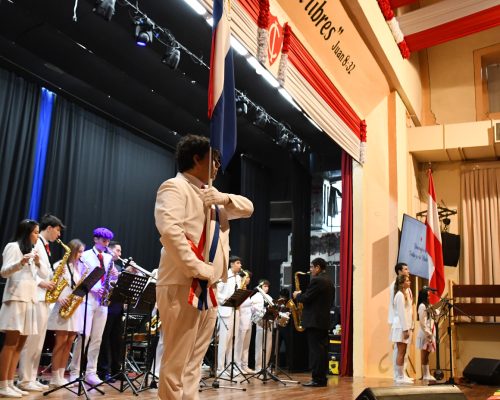
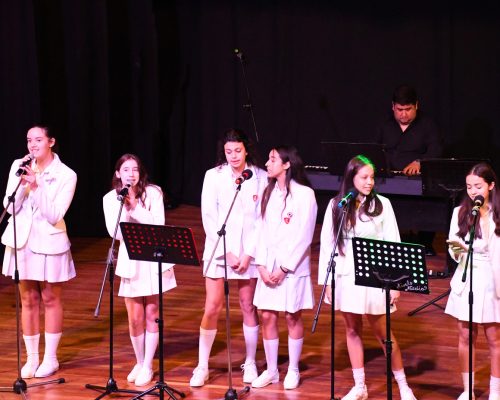
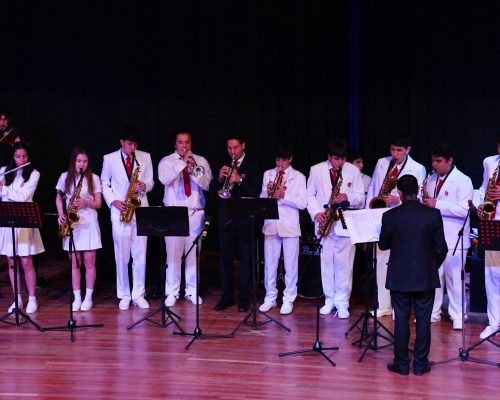
“One of the important pillars offered by the school is the education through Art; space nurtured from the beginning of their educational activities, brought by the american missionaries, in order to develop the creativity through various expressive means.
The music education enables the acquisition of knowledge to allow them to appreciate great works of music, national and international, to interpret them through singing and instrumental practice. Within the institutional program is intended to 80 minutes for each mode in the workshops of the choir, guitar, wind instruments, violin and percussion, at 3.er Cycle, to then form the ensembles and musical Jazz Band in Middle school. We conceive of Art as an attitude to life, a means to express feelings and emotions, where the process of production and experimentation with different techniques, in Visual arts, it is even more important that the final production. Play to interpret, to create links, to gain confidence in one's self, to integrate through dramatic play, put yourself in the place of the other to understand situations and expressing them, are promoted in the workshops of Theatre and discover the multiple expressive possibilities bodily through the different proposals for the creation or the learning of choreography simple, complex, made in the workshops of Dance allow to strengthen the identity, valuing one another, taking on values of solidarity, respect for diversity, tolerance and the importance of working in a team provides each student with a number of benefits as a basis for the acquisition of skills and competencies necessary for life”.
The Area of Physical Education in the secondary school is composed of the Third Cycle (7.º, 8.Th and 9.Grade) and Middle school (1.er, 2.º and 3.er Course).
The area is the physically largest of the International College, as it represents approximately 40% of the surface area of the institution, which, with its load time of two times a week for 80 minutes allows you to develop program curriculum MEC and the International School.
Physical education promotes the balance biopsychosocial through reflection, awareness, and the systematic practice of physical activities, in addition to providing the knowledge of your own body, which leads to the acceptance of the same.
It also constitutes a valuable instrument of social relationships to express feelings and to create codes of communication in situations of sport practices, gymnastic and recreational healthy. Likewise, bears a close relation to education, to health, since the young man requires the development of capabilities that entails habits in the practice of physical exercises, hygiene and a balanced diet in order to build a model of a healthy lifestyle.
Apply physical qualities, organic, and neuromuscular, and the fundamentals technical-tactical in the systematic practice of physical activities, sports and recreational facilities, within an ethical framework, in order to build a model of a healthy lifestyle.
Curriculum: Within the activities of the school year is done the program development of the EQF and the program of the International College, such as:
Extra-Curricular: To develop a program of sports training and skills to level Interbásico and Intercollegiate.
In terms of the medical certificate, is a document by which this is to certify, endorse, and confirms the physical condition and the state of health of young people. It is important that at the beginning of each year to perform these controls, in order to safeguard the integrity of the student.
These controls should be mandatory and should be performed by professionals qualified and competent in the area, that can issue the document with the signature, the seal and the record that enables it.
Medical certificates should contain the basic information necessary to determine if a youth is in or not in conditions of physical activities, sports, leisure, as well as the reasons why you can't achieve them in case of not be found in conditions.
Parents need to know with clarity the importance of their children to perform this test and have the doctor's certificate, an updated one, as it concerns the physical safety of their children.
The proposal educational institutional, covers the implementation of the technology in the modalities of the System of Computing in Education (SIE), and the System of Computer Education (SEI).
We have five computer labs, with 16 computers connected to a network of high speed Internet and with appropriate filters that provide security for the students to browse the web.
Develop classes using the computer resource to support the development of skills and content from the different areas of the school program in English and Spanish, as well as train skills of coexistence relate to the task team, the care of the materials and the respect of others.
The English and Spanish language classes are prepared by the teachers/teachers in conjunction with the faculty of Educational Computing in the form of:
The Christian Education of relevance in the education of the whole, because it challenges you to live the true christianity, in a genuine relationship with Christ in experiences of values and principles, this means a process of discovery and development of a love relationship between God (the Father, the Son, E. Santo) the neighbor, and ourselves, with teaching gradual and activities that reinforce the teaching. The goal is to know yourself, respect yourself, respect others, and especially to acknowledge God as Creator and Savior, giving priority in the daily life, and also appreciating all of nature, as his creation.
Our faith in Jesus Christ as Lord and Savior is the conviction that determines a specific lifestyle, where all men and women are children of God and therefore brothers and sisters, and we have the same rights and obligations. In our Creed, we express the christian principles that give north our life, because our faith is alive and is witnessed in all of our actions.